PUBLIC PRESSURE
A downloadable tabletop RPG
SMILE. COMPLY. DENOUNCE YOUR FRIENDS.
PUBLIC PRESSURE is a conversation-driven tabletop role-playing game about social conformity, weaponized kindness, and the terror of saying the wrong thing.
Welcome to the Wellness Society, where every citizen must remain positive, cooperative, considerate, and socially clean. Laugh at the wrong moment. Hesitate before agreeing. Allow one unsuitable feeling to escape. Someone at the table may denounce you.
This is not merely dystopian horror. It is also a painfully sad comedy about decent people choosing their words so carefully that they end up hurting one another with perfect politeness. There are no villains, which is why it is funny. Someone still disappears, which is why the laughter catches in your throat.
There are no monsters to defeat and no dungeon to escape. The danger is the conversation itself.
WE WANT TO SEE YOUR SESSIONS
If you stream or upload a session to YouTube, please send it our way. Whether it turns into a painfully tense tangle of human relationships or an absolutely hilarious comedy sketch, we genuinely want to watch it. Please do!
WHAT YOU GET
- A 62-page English rulebook with a clickable table of contents
- A 47-page English scenario collection containing three ready-to-play scenarios
- Rules for denunciation, defense, Purity, public duties, Noise, and several deeply reassuring endings
- Digital PDF edition for online or in-person play
PLAY INFORMATION
- Players: 1 GM + 3-5 players (4 recommended)
- Prepare: Two six-sided dice, writing materials, and denunciation chips
- Format: In person or online
- Language: English
Playing time varies according to your proficiency in carrying out your duties and the richness of the conversation. The Bureau respectfully declines to provide a more useful estimate.
FROM THE ARCHIVES
THE CONTROLLER'S EDGE 001: PUBLIC PRESSURE
Reprinted from BOUDOIR NOTE, TINMOON's fictional cross-breed culture magazine.
Words by Ichinose Mitsu
WAS THAT AN APPROPRIATE THING TO SAY?
We watch the faces around us. We read the atmosphere. We choose words that will not disturb anyone's feelings. What if this "appropriate consideration," performed as naturally as breathing by those of us living today, were both your lifeline and the noose tightening around your neck?
Game design: TINMOON. System: PUBLIC PRESSURE.
The table presented here depicts an extreme dystopia of the "Sterile Society": a world whose inhabitants depend upon, disclose themselves through, and remain terrified of public judgment. What the players are asked to do is neither make heroic decisions nor solve an elegant mystery. They must continue performing the absolute correctness demanded by the room. Nothing more.
But if even one step of that performance falls out of rhythm, social or institutional erasure awaits. Through its mechanics of dialogue and public pressure, the game shakes the players' ethics and survival instincts to their limits. Excessive consideration turns into dystopian horror. Turn it over, and an exquisite piece of dark comedy appears beneath it. This merciless system wears both faces.
Yet to read PUBLIC PRESSURE as dystopia alone is to miss half of it. It is a painfully sad sketch comedy about people who want to be decent, who choose their words so carefully that they end up hurting one another with flawless courtesy. No one needs to be evil. That is why it is funny. Someone is erased anyway. That is why the laughter arrives with grief folded inside it.
THE COLOR OF STERILITY
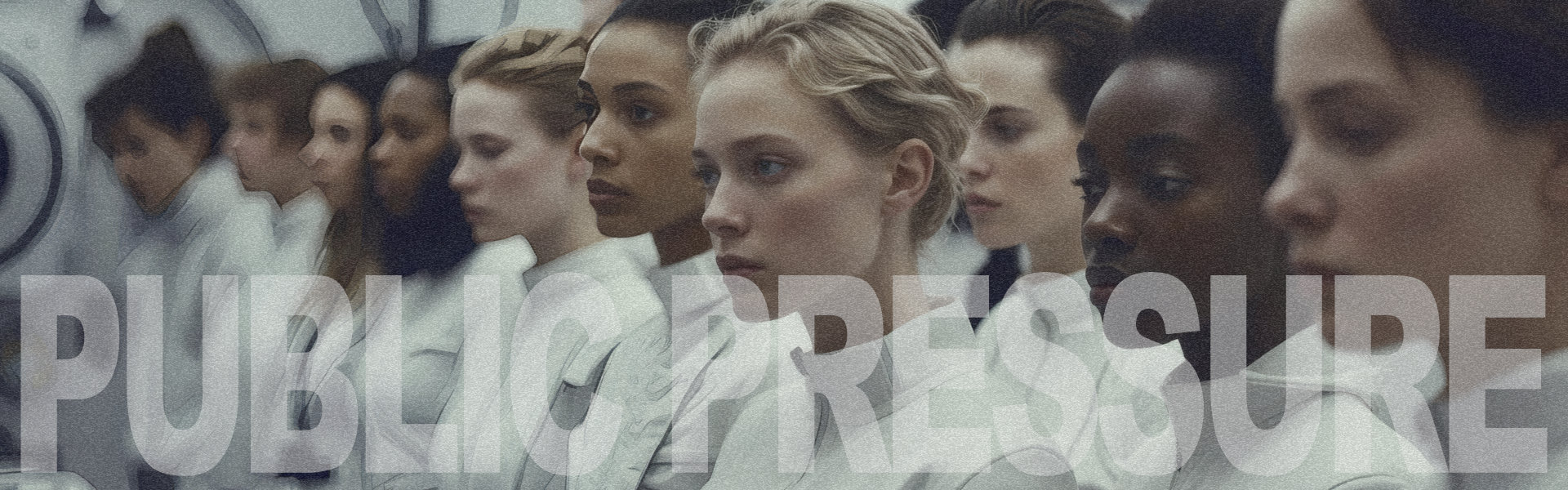
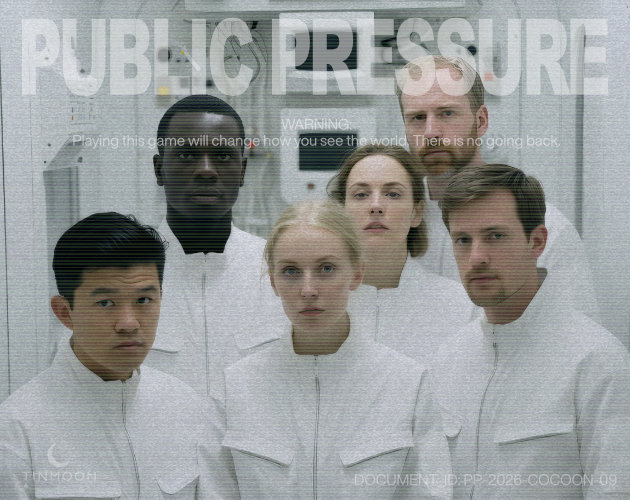
There is one color that cannot be avoided when discussing the setting of PUBLIC PRESSURE: sterile white.
This does not mean the clean white of innocence. It is the white of a sterile room: deodorized, disinfected, and intolerant of every contaminant, stain, or discordant noise. The world of the game may be viewed through two utterly different lenses, connected at their roots.
The first lens reveals an inescapable, quiet terror. Everyone is required to be good, considerate, and cooperative. Words that might hurt another person and attitudes that might disturb harmony are immediately excluded as "inappropriate." This is not the violent oppression of classical dystopian fiction. It is quieter, more sophisticated, more strategic, and cold enough to reach the bone.
Everyone smiles. Everyone exchanges immaculate formalities and excessive concern. Meanwhile, each pair of eyes watches for the smallest flaw in another person's social cleanliness. A single slip of the tongue, or one brief silence that fails to read the room, may be fatal. Everyone is an aggressor. Everyone may become the next victim. This layer of total dystopia tightens itself firmly around the players' chests.
DARK COMEDY WITH PERFECT MANNERS
Look through the second lens, however, and the world abruptly becomes an exceptional comedy.
Human beings concealing their nature while trying to perform perfectly well-behaved dolls are objectively ridiculous. Under the restriction that no one may speak honestly, the players watch one another's expressions and pile up phrases of agreement, trying not to deviate by a single millimeter.
I think that is wonderful. Yes, naturally, if everyone agrees then that must be correct. What an excellent opinion. I was thinking exactly the same thing.
The exchange of beautiful phrases becomes entirely hollow. Because one mistake means ruin, the players' desperate attempts at consideration function as humor that no one should laugh at and no one can resist. The game exaggerates and condenses that strangely artificial atmosphere many of us have encountered in meetings, communities, or social media, then places it on the table.
It is not merely satire aimed at cruel people. Its sharper joke is that the people may be sincere. They may genuinely wish to protect one another. They simply cannot stop the machinery that turns protection into surveillance and kindness into a weapon. The resulting comedy is ludicrous, tender, and almost unbearably sad.
TWO ROOMS WITH NO EXIT
To understand the game's appeal more concretely, consider the opening situations of two scenarios included in the collection. The instant the opening buzzer sounds, both drag the players into a psychological contest with no obvious escape.
Welcome Party for the Absent takes place in a corner of a large corporation: a polished modern office governed by rationality and discipline. In ordinary life, we preserve institutional harmony by covering what must not be seen and filtering what must not be said. The players seated here are required to carry that behavior to its limit.
Businesslike smiles pass across the room. A formal celebration is performed to avoid causing trouble. Beneath its beautiful surface waits a brutal rule: take one wrong step and the system may eject you. Everyone chooses their words with painful care, struggling to remain the correct kind of employee. The room feels like the awkward silence of a familiar meeting, concentrated until it becomes difficult to breathe.
The second setting is even closer to everyday life and, in some ways, offers less possibility of escape: the Sakura Elementary PTA. Few places demand more goodwill, responsibility, and cooperation than a closed local or school community.
No one gathered there needs to possess a trace of malice. Everyone wishes to behave correctly. Everyone wants peace. Everyone restrains themselves for somebody else's sake. That is precisely what makes the room frightening.
Adults bound by the beautiful chains of obligation and responsibility watch how the others move and exchange blades made of courteous language. They smile and pretend to respect one another while carefully avoiding the displeasure of the invisible creature called community. Reveal one private fact or honest feeling and you may instantly become its foreign body.
This structure of mutual surveillance is painfully familiar and absurd. "No one is bad, yet everyone is afraid" is already enough to promise a dense human drama. What happens after the meeting begins is reserved for those who actually take a seat.
WHEN THE RULES MAKE THE STORY HAPPEN
What makes PUBLIC PRESSURE work as a tabletop role-playing game is that it does not leave its dystopian tension and comic absurdity entirely to the players' acting. It gives them mechanical bodies.
At the center of the system is Purity, the measure of a citizen's social cleanliness. Each time a player speaks or acts, the table may question whether the behavior was appropriate for the occasion. Perfect conformity preserves Purity. The smallest impropriety or fragment of honest feeling may reduce it without mercy.
The system's cruelest property is simple: when another person's Purity falls, your own chance of survival rises by comparison. To protect themselves, players politely identify one another's smallest mistakes.
Was that not somewhat inappropriate?
I say this only because I care about you.
Counseling becomes pursuit. Concern becomes pressure. These are not accidental moods but explicit rules, and so the table alternates between laughter resembling a scream and silence in which no one can breathe.
The rules drive the story. The system compels players to experience violence performed in the name of consideration. That is the central victory of the game's design.
TO LAUGH, AND THEN TO FEEL SORRY
The world of PUBLIC PRESSURE is not distant science fiction. It is a miniature of the workplace you may enter tomorrow morning, the community meeting you cannot politely refuse, or the screen of the phone already in your hand.
You may enjoy its suffocation as pure dystopian horror. You may laugh at human self-preservation as dark comedy. But the game keeps returning to a third feeling: pity for people who have tried so hard to remain kind, safe, and acceptable that they can no longer recognize what they are doing to one another.
No scenario ending will be revealed here. To do so would offend the aesthetics of this perfectly disinfected world.
Only one thing is certain. Once you take your seat at this table, you are no longer permitted to speak honestly. The chairs have already been painted a dazzling white.
Everyone is smiling.
Everyone is waiting for your first sentence.
Content note: PUBLIC PRESSURE deals with social exclusion, mutual surveillance, public denunciation, coercive conformity, and emotional suppression. Discuss boundaries before play and take care of one another after the operation has concluded.
Generative AI disclosure: This project contains visual material produced with generative AI tools and subsequently selected, edited, and laid out by TINMOON.
Purchase
In order to download this tabletop RPG you must purchase it at or above the minimum price of $5 USD. You will get access to the following files:
Leave a comment
Log in with itch.io to leave a comment.